
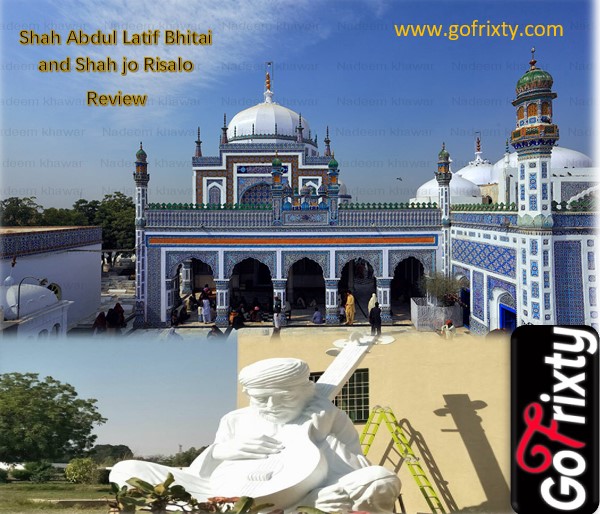
Hazrat Shah Abdul Latif Bhitai
Shah Abdul Latif Bhitai was born in the House of Shah Habib ( his father) on 18 November 1689 in the village of Hala Haveli, a few miles to the east of the present town of Bhit Shah (named after him). Shah Abdul Latif Bhitai was raised during the golden age of Sindhi culture. His first teacher was Akhund Noor Muhammad Bhatti, although he was largely self-educated.
Shah Abdul Latif Bhittai was a Sindhi Sufi Scholar, mystic, Saint, and a Poet. Shah Abdul Latif Bhitai is yet widely considered to be the greatest Muslim Poets of Sindh. The pieces of the poetry of Shah Abdul Latif Bhitai are assembled in the Compilation of Shah Jo Risalo. which exists in numerous versions and has been translated into English, Urdu, and many other languages. The great poet, mystic, Philosopher and Sufi scholar named Shah Abdul Latif Bhitai died on 1st January 1752. The Shrine of Shah Abdul Latif Bhitai is in BhitShah.
Translations of the book, “Shah jo Risalo”
Shah jo Risalo was first translated into German scholar in 1866 named Earnest Trump. In the 1860s, Earnest Trump got awestruck by Sindhi language, culture, the Jogis, and singers who used to sang Shah Abdul Latif Bhitai’s poetry from Shah jo Risalo. With the help of Sindhi scholars, he compiled a selection of the original verses and called it “SHAH JO RISALO” (the message of shah).
It was later translated in the English language by Elsa Kazi, a german lady, the wife of Allama I.I Kazi, who translated selections of SHAH Jo RISALO in English prose. Later in 1940, Dr H.T Sorely, an English scholar learnt the Sindhi language, and published selections from the Shah jo Risalo through Oxford university press entitled “Shah Abdul Latif of Bhit – his poetry Life and times”.
The most recent work (1994) of translation of Shah jo Risalo into English is that of Amena Khamisani, a professor in English Literature at the University of Sindh. Shaikh Ayaz, the famous Sindhi poet, translated Risalo into Urdu language. Risalo is also translated in Punjabi language and more recently French translation was also undertaken by the Cultural Department of Sindh. Part of Risalo is also translated in the Arabic language. There is one more translation of Shah Abdul Latif by the name “Seeking The Beloved” translated by Hari Daryani ‘Dilgir’ a noted Sindhi poet and Anju Makhija. This book was honoured with the Sahitya Academy Award for translation in the year 2012.
Surs, the chapters of Shah jo Risalo
The oldest Publications of Shah Jo Risalo Contained 36 SURS, but later most of the linguists discarded 6 Surs, as their language and content did not match the Shah’s Style. Recently, Dr NABI BUX BALOUCH, a renowned linguist of the Sindhi language, has compiled and printed a new addition after 32 years of research into folk Culture, language and the history of Sindhi language. In which he has modified the Risalo and limited it to 30 Surs.